
🌄 Introduction: A Hill Where the Heart Becomes Light
In the quiet hills of Himachal Pradesh, where the wind moves gently through forests and the mind slows down naturally, stands a sacred shrine known as Chintpurni Shakti Peeth. Pilgrims do not come here looking for grandeur or spectacle. They come with burdens on their hearts—unspoken fears, unanswered prayers, and restless thoughts.
The name Chintpurni means “the Mother who removes worries.” For generations, devotees have believed that when prayers are offered here with sincerity, anxieties dissolve and clarity arises. This is a temple not of noise, but of relief—where the Divine Mother listens patiently and responds through peace.
🕉️ Why Chintpurni Is a Shakti Peeth
Chintpurni Shakti Peeth is revered as one of the 51 sacred Shakti Peethas, divine sites formed where parts of Goddess Sati’s body fell after her ultimate sacrifice.
According to ancient tradition, Sati’s head or forehead is believed to have fallen at this spot. Some regional beliefs also associate the site with her feet. Because of this sacred association, the Goddess is worshipped here in her powerful form as Chhinnamasta, the self-sacrificing Mother who cuts through fear and illusion.
At the same time, devotees lovingly call her Chintpurni—the compassionate form of the Mother who removes mental suffering and grants reassurance. The accompanying Bhairava at this Peeth is known as Rudra Mahadev, symbolizing protection and balance.
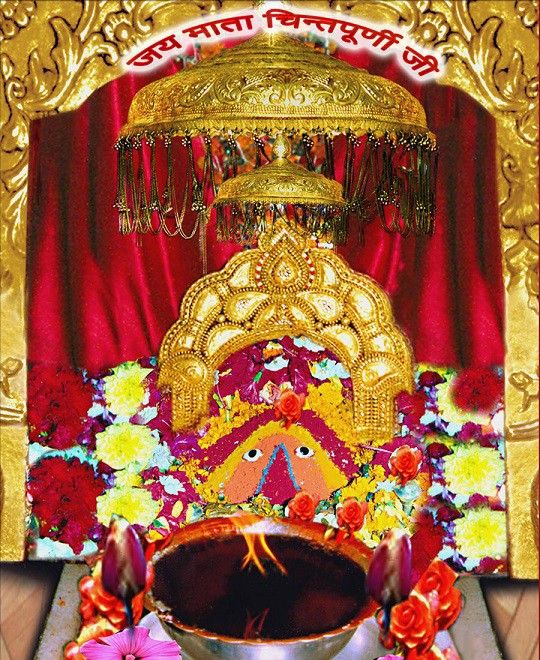
📖 The Story of Sati and the Birth of Chintpurni
Long ago, Goddess Sati, daughter of King Daksha, married Lord Shiva against her father’s wishes. When Daksha organized a grand yajna and deliberately insulted Shiva, Sati could not bear the humiliation of her beloved. In grief and devotion, she sacrificed herself in the sacred fire.
Lord Shiva, shattered by sorrow, carried Sati’s body across the cosmos and performed the Tandava, the dance of destruction. To restore universal balance, Lord Vishnu used the Sudarshana Chakra, gently dividing Sati’s body. Wherever a part fell, a Shakti Peeth emerged.
At Chintpurni Shakti Peeth, the fall of Sati’s head gave rise to a place where mental burdens are lifted. Devotees believe that the Mother here absorbs worries the way the earth absorbs rain—silently and completely.
⛰️ Geography of Grace: Where the Temple Stands
Chintpurni Shakti Peeth is located in the Una district of Himachal Pradesh, near the border with Punjab. Sitting at an elevation of around 940–977 meters, the temple is nestled among the low Shivalik hills, surrounded by forests and seasonal streams.
The landscape itself feels calming. Unlike high Himalayan shrines that test endurance, Chintpurni welcomes pilgrims gently. The approach roads are smooth, and the surrounding greenery invites the mind to slow down even before darshan.
This gentle geography reflects the nature of the Goddess herself—firm yet comforting.
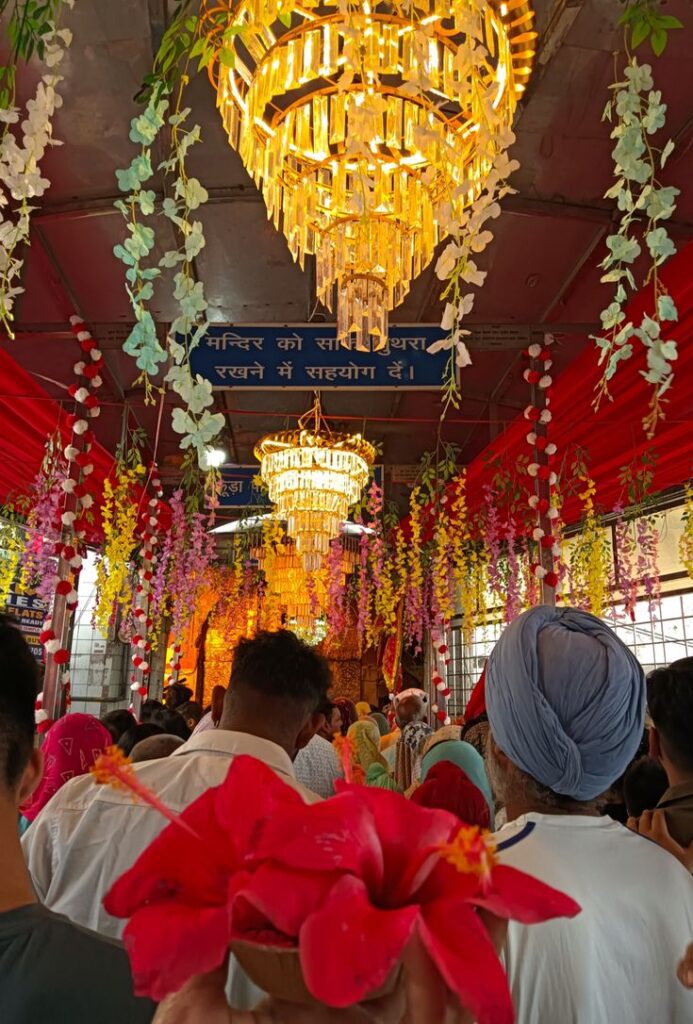
🏛️ The Temple and the Sacred Darshan
Inside the sanctum of Chintpurni Shakti Peeth, there is no sculpted idol. The Goddess is worshipped in the form of a pindi (sacred stone)—ancient, simple, and deeply powerful.
The absence of an anthropomorphic idol allows devotees to connect directly with the formless presence of the Mother. Faith here does not depend on appearance; it rests on trust.
Offerings commonly include:
Chunri (red cloth)
Coconuts
Sindoor
Flowers and sweets
Four Shiva shrines are believed to symbolically surround the sanctum, representing cosmic balance and unity.
🌸 History and Living Tradition
Local tradition attributes the establishment of the temple to Pandit Mai Das, a 16th-century saint who, guided by divine vision, built the shrine and began organized worship.
Over centuries, local rulers, community trusts, and devotees have preserved the temple, rebuilding and expanding facilities while maintaining its spiritual simplicity. Earthquakes, time, and modernization have come and gone—but the faith here remains steady.
Even today, the temple functions as a living center of devotion, not a monument of the past.
🎉 Festivals: When Devotion Overflows
During Navratri—both Chaitra and Sharad—the temple becomes a river of devotion. Thousands arrive on foot, chanting the Mother’s name, offering prayers, and lighting lamps.
Another important event is the Sawan / August Mela, when pilgrims from Punjab and neighboring regions undertake long foot yatras. Monthly observances like Sankranti and Poornima also draw large crowds, accompanied by community kitchens (langars) that feed all without distinction.
During these times, the temple feels alive—not crowded, but shared.
🌺 Spiritual Significance: Why Devotees Come Here
Chintpurni Shakti Peeth is especially associated with:
Relief from anxiety and mental stress
Fulfillment of sincere wishes
Guidance during confusion or difficult decisions
Family harmony and emotional healing
Many devotees follow a heartfelt tradition:
they return to the temple after their wish is fulfilled to offer gratitude. This reinforces a relationship based not on demand, but on trust.
Spiritually, Chintpurni teaches a simple truth:
✨ Surrender does not weaken—it heals.
🚗 How to Reach Chintpurni Shakti Peeth
✈️ Nearest airports: Chandigarh, Adampur (Jalandhar), Gaggal (Kangra)
🚆 Nearest railway stations: Una Himachal, Amb Andaura, Hoshiarpur
🚌 Well-connected by buses and taxis from Chandigarh, Jalandhar, Una, Kangra
The final approach is motorable, with only a short walk to the temple entrance.
🛕 Nearby Pilgrimage Circuit
Chintpurni is often visited along with:
Chamunda Devi
Naina Devi
Mansa Devi (Haryana)
Together, they form a powerful Himachal–Punjab Shakti circuit, usually completed in two to three days.
🤍 Etiquette and the Spirit of the Place
Pilgrims are encouraged to:
Dress modestly
Maintain silence near the sanctum
Respect queues and local customs
Avoid plastic and litter
At Chintpurni, discipline feels natural—because the atmosphere itself invites calm.
🌟 Conclusion: From Worry to Trust
Chintpurni Shakti Peeth is not about dramatic miracles.
It is about what quietly lifts.Here, the Divine Mother does not command—She reassures.
She does not hurry—She waits.
She does not judge—She understands.When devotees leave this hill shrine, they may still carry responsibilities—but their hearts feel lighter. That is the Mother’s blessing.
In a restless world, Chintpurni reminds us that peace is not something we achieve.
It is something we receive—when we finally let go.